What Is GEO? Generative Engine Optimization Guide
By Greg Arnold
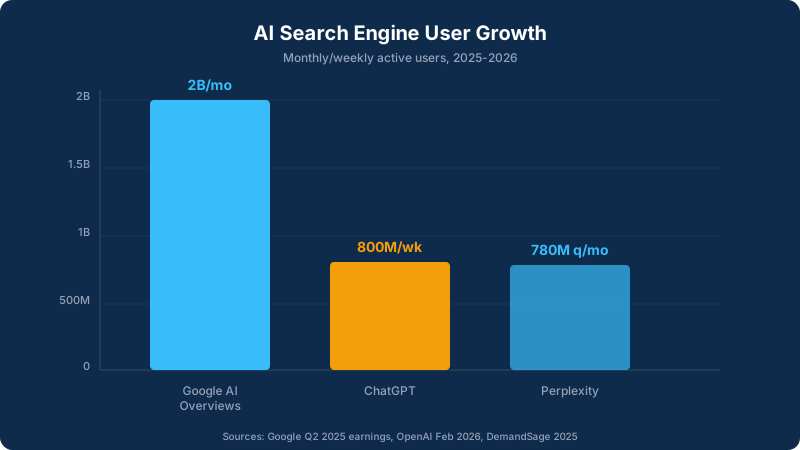
GEO (Generative Engine Optimization) is the practice of optimizing digital content so that AI search engines can find it, extract it, and cite it in their generated answers. ChatGPT reached 800 million weekly active users as of February 2026. Google AI Overviews serve 2 billion monthly users across 200 countries. Perplexity processes 780 million queries per month. The shift is not coming. It happened.
If your content does not appear in AI-generated answers, a growing majority of your potential audience will never see it. There is no "page two" of a ChatGPT response. There is the answer, and there is everything else.
Why GEO matters now
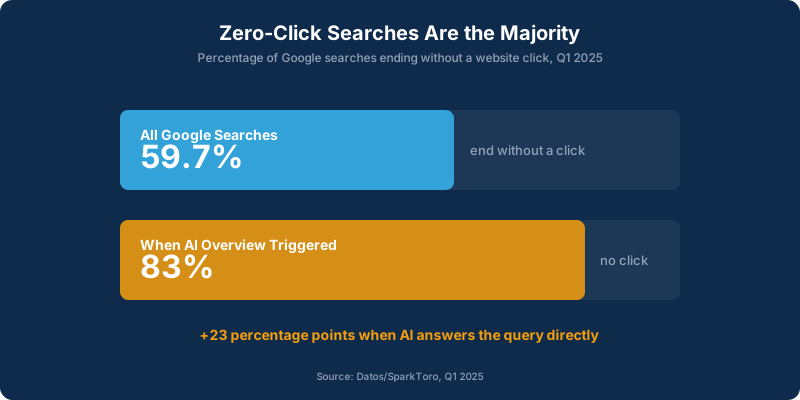
Traditional search is contracting. 59.7% of Google searches now end without a click to any website, according to Datos and SparkToro's Q1 2025 analysis. When Google's AI Overview triggers, that figure rises to 83%. The user gets the answer directly. The websites that were not cited get nothing.
This is not a temporary dip. It is a structural shift in how people find information online.
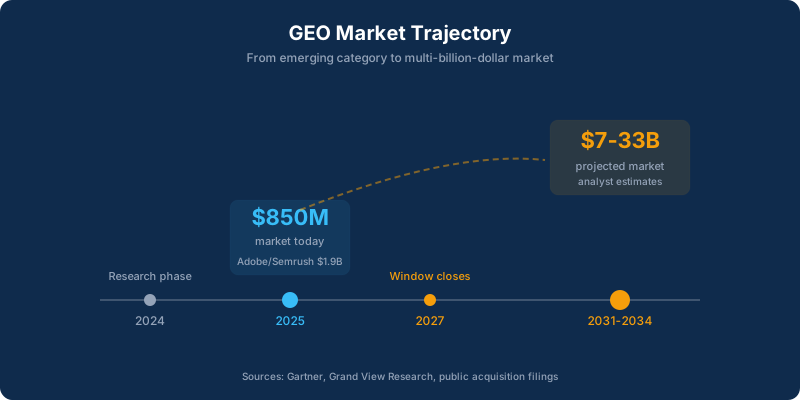
The GEO market reflects this urgency. Adobe acquired Semrush for $1.9 billion in November 2025, signaling that enterprise software companies view AI search optimization as a core capability. Analyst estimates place the current GEO market at approximately $850 million, with projections ranging from $7 billion to $33 billion by 2031-2034 depending on how quickly traditional search budgets migrate to AI visibility.
GEO vs. SEO: what changed
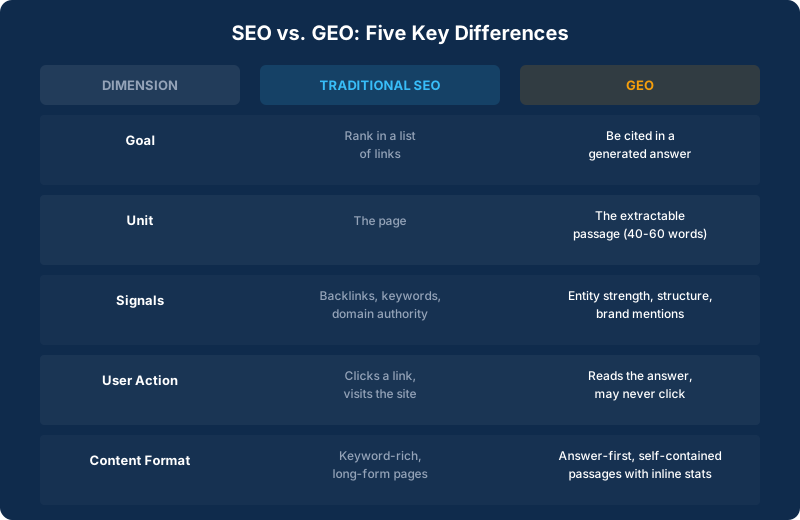
GEO is not a rebranding of SEO (Search Engine Optimization). The mechanics are different. The unit of competition is different. The signals that determine success are different.
In traditional SEO, you compete for a position in a list of ten links. In GEO, you compete for a citation inside an AI-generated answer. SEO optimizes pages. GEO optimizes extractable passages of 40 to 60 words. SEO relies on backlinks and keywords. GEO relies on entity strength, content structure, and brand mentions across the data sources AI models consume.
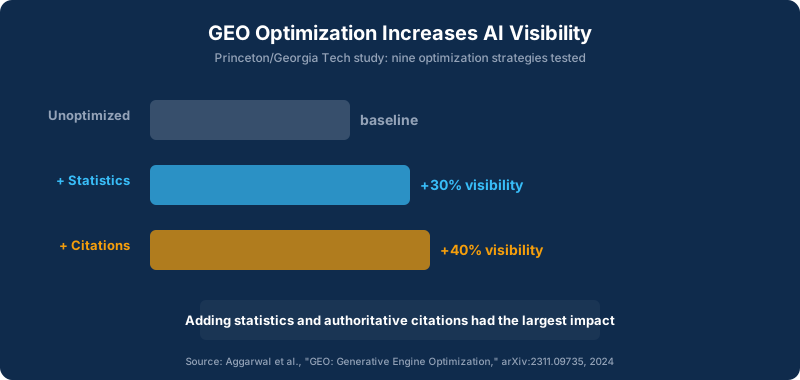
The foundational GEO research paper by Aggarwal et al. from Princeton University, Georgia Tech, the Allen Institute for AI, and IIT Delhi tested nine optimization strategies. Content that added inline statistics and authoritative citations saw 30 to 40% increased visibility in AI-generated responses. Backlink count, the primary signal in traditional SEO, showed minimal effect.
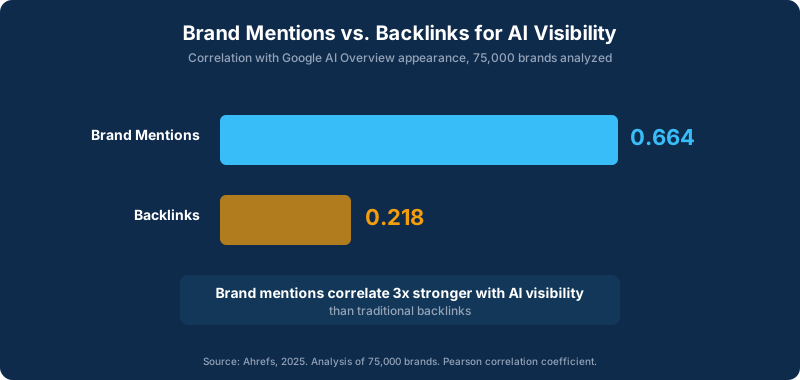
An Ahrefs analysis of 75,000 brands confirmed this shift. Branded web mentions showed a 0.664 Pearson correlation with AI Overview visibility. Traditional backlinks correlated at just 0.218. Brand mentions matter three times more than backlinks for AI search visibility.
How AI engines decide what to cite
Understanding GEO requires understanding the citation pipeline. AI search engines follow a four-stage process when generating answers.
Stage 1: Retrieval. The AI system rewrites the user's query, searches its index, and retrieves candidate pages. Google AI Overviews pull from Google's existing search index. Perplexity uses its own index and Bing's API. ChatGPT Search uses its browsing infrastructure. If your page is not indexed or is blocked by robots.txt, the process ends here.
Stage 2: Extraction. Raw HTML is stripped to plain text or markdown. Navigation, ads, and boilerplate are removed. Pages built with semantic HTML survive this step cleanly. Approximately 40% of web content requires JavaScript to render, and 69% of AI crawlers cannot execute JavaScript, according to HTTP Archive and SearchVIU data. That content is invisible to most AI systems.
Stage 3: Chunking. Extracted text is split into segments at heading boundaries and paragraph breaks. Each chunk is embedded as a vector and compared against the user's query. Pages with clear heading hierarchy and self-contained passages produce higher-quality chunks that rank better.
Stage 4: Synthesis and citation. The model generates a response using the highest-ranked chunks and attributes claims to their sources. Content with specific data points, named sources, and verifiable statistics is more likely to receive explicit citation.
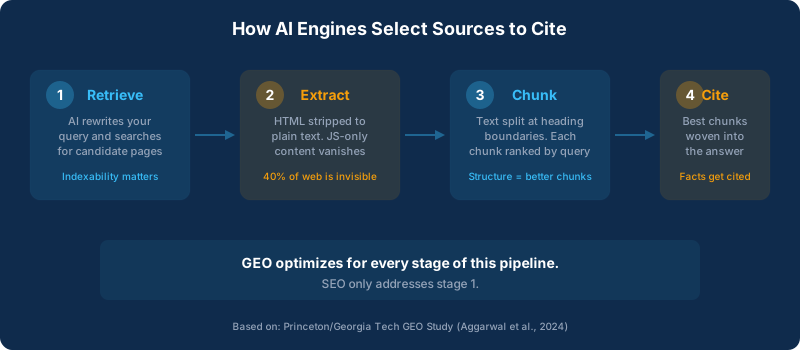
GEO optimizes for every stage of this pipeline. Traditional SEO primarily addresses stage 1.
The three areas of GEO
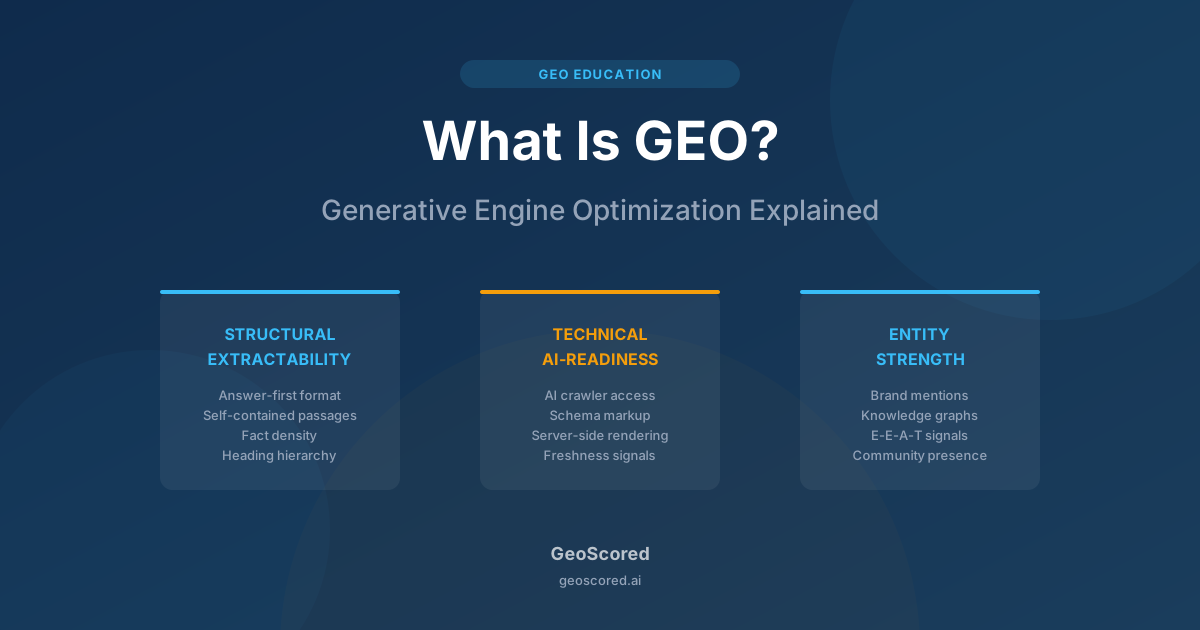
GEO breaks into three interconnected areas. Each represents a distinct set of practices, and all three must work together for a page to be consistently cited by AI systems.
Structural extractability
This is the content layer. AI models do not read pages the way humans do. They scan for passages that directly answer a question, contain verifiable facts, and can stand alone without surrounding context. Content optimized for structural extractability leads each section with a direct claim rather than setup language. It uses question-based headings that AI models can match to user queries. It maintains fact density with inline statistics and specific data points. And it keeps passages self-contained at 40 to 60 words, so any individual paragraph can be extracted and cited independently.
The Princeton/Georgia Tech study demonstrated that these structural optimizations produce measurable results. Adding statistics increased visibility by up to 30%, and citing authoritative sources increased it by up to 40%.
Technical AI-readiness
This is the infrastructure layer. Your content can be perfectly structured, but if AI crawlers cannot access it, the structure is irrelevant. Technical AI-readiness includes server-side rendering so content is available before JavaScript execution, schema markup in JSON-LD format that tells AI systems what entities your content represents, robots.txt configuration for the 200+ AI bot user agents now crawling the web, and freshness signals like dateModified schema values.
35.5% of the top 1,000 websites block GPTBot, according to Originality.ai research. Many businesses are blocking AI crawlers without realizing it, making their content invisible to the fastest-growing search channel.
Entity strength
This is the brand recognition layer. AI models form their understanding of brands from training data and real-time retrieval sources: Wikipedia, Crunchbase, LinkedIn, Reddit, press coverage, and knowledge graphs. A brand that is described consistently across these sources gives AI models high confidence when citing it. A brand with contradictory or sparse entity data gets mentioned less frequently, regardless of content quality.
Your brand already has an AI reputation, whether you manage it or not. The question is whether AI models describe your brand accurately and recommend it confidently.
What GEO is not
GEO is not a replacement for SEO. Traditional search still drives significant traffic, and the technical foundations of SEO (crawlability, site speed, mobile optimization) remain relevant to AI systems. GEO builds on top of SEO. It adds the structural and entity-level optimizations that AI search engines require on top of the technical baseline.
GEO is not citation monitoring. Tracking whether AI engines mention your brand tells you what happened yesterday. It cannot tell you why, and it cannot tell you what to change. Monitoring is useful only after the structural work is done. An audit identifies the structural problems. Monitoring tracks whether fixing them worked.
GEO is not prompt engineering. Prompt engineering optimizes the input to an AI model. GEO optimizes the content that AI models retrieve when generating their responses to those prompts. They operate at different layers of the stack.
How to start with GEO
The practical starting point for GEO is an audit. You cannot optimize what you do not measure. A GEO audit evaluates your content across the three areas described above: structural extractability, technical AI-readiness, and entity strength. It identifies specific gaps and provides a prioritized list of fixes.
GeoScored runs scored checks across five categories, producing a score from 0 to 100 with specific recommendations for every check that needs attention. The five categories, Content Quality, AI Discovery, Brand Authority, Citation Readiness, and Site Health, map directly to the structural properties that AI engines evaluate when selecting sources to cite.

The most common fixes from a GEO audit are structural, not technical. Rewriting section openings to lead with claims instead of setup language. Breaking long paragraphs into self-contained passages. Adding inline statistics with source citations. Implementing schema markup that identifies the content's entity type, author, and publication date. These changes do not require a website redesign. They require editorial discipline and a clear understanding of how AI engines process content.
The market for GEO services and tools is growing faster than any adjacent category in digital marketing. The first-mover window, roughly 2025 to 2027, is open now. Businesses that establish their AI search visibility during this period will carry a structural advantage as AI-generated answers become the default interface for information retrieval.
Run a free AI Visibility Screening at geoscored.ai to see where your content stands across all five categories, with specific recommendations for every check.
Sources
-
OpenAI / DemandSage. "ChatGPT Statistics." February 2026. ChatGPT reached 800 million weekly active users. https://www.demandsage.com/chatgpt-statistics/
-
Google / TechCrunch. "Google's AI Overviews have 2B monthly users." July 2025. Statement from Google CEO Sundar Pichai on Q2 2025 earnings call. https://techcrunch.com/2025/07/23/googles-ai-overviews-have-2b-monthly-users-ai-mode-100m-in-the-us-and-india/
-
DemandSage. "Perplexity AI Statistics and Revenue." May 2025. 45 million MAU and 780 million queries per month. https://www.demandsage.com/perplexity-ai-statistics/
-
Datos / SparkToro. "State of Search Q1 2025." 59.7% zero-click rate; 83% zero-click when an AI Overview is triggered. https://datos.live/report/state-of-search-q1-2025/
-
Aggarwal, P., Murahari, V., Rajpurohit, T., Kalyan, A., Narasimhan, K., & Sabharwal, A. "GEO: Generative Engine Optimization." arXiv:2311.09735. Princeton University, Georgia Tech, Allen Institute for AI, IIT Delhi. 2023, revised 2024. https://arxiv.org/abs/2311.09735
-
Ahrefs. "Brand Mentions vs. Backlinks: AI Visibility Correlation Study." 2025. Analysis of 75,000 brands. https://ahrefs.com/blog/brand-mentions-vs-backlinks-ai-visibility/
-
Reuters. "Adobe to Buy Semrush." November 2025. Adobe acquired Semrush for $1.9 billion. https://www.reuters.com/technology/adobe-buy-semrush-2025-11-12/
-
Gartner. "Gartner Predicts Search Engine Volume Will Drop 25% by 2026." February 2024. https://www.gartner.com/en/newsroom/press-releases/2024-02-19-gartner-predicts-25-percent-decrease-in-traditional-search-volume-by-2026
-
HTTP Archive. "Web Almanac 2024: JavaScript Usage and Rendering." https://almanac.httparchive.org
-
Originality.ai. "The Current State of AI Bot Blocking." 2024. https://originality.ai/blog/ai-bot-blocking-statistics
-
Dark Visitors. AI bot user agent database. 200+ AI crawler user agents tracked. https://darkvisitors.com