Your Brand Has an AI Reputation. You Probably Don't Know What It Says.
By Greg Arnold
When someone asks ChatGPT or Perplexity to recommend a company in your category, your brand either appears accurately, appears with errors, or doesn't appear at all. That outcome is determined by signals most marketing teams have never measured. An Ahrefs analysis of 75,000 brands found that branded web mentions have a higher correlation with AI visibility than any other off-page signal tested, including backlinks, branded search volume, and domain authority. Most businesses have no idea where they stand.
This is not about posting more content or running more ads. AI (Artificial Intelligence) engines build their understanding of brands from structured databases, third-party mentions, industry directories, and cross-referenced facts across the public web. The density and consistency of that data determines whether an AI engine can accurately describe your business and whether it chooses to recommend you.
Backlinks built your SEO authority. Brand mentions build your AI authority.
For two decades, the unit of authority in search was the backlink. More links from high-authority domains meant higher rankings. That logic still holds for traditional search results. AI engines calculate authority differently.
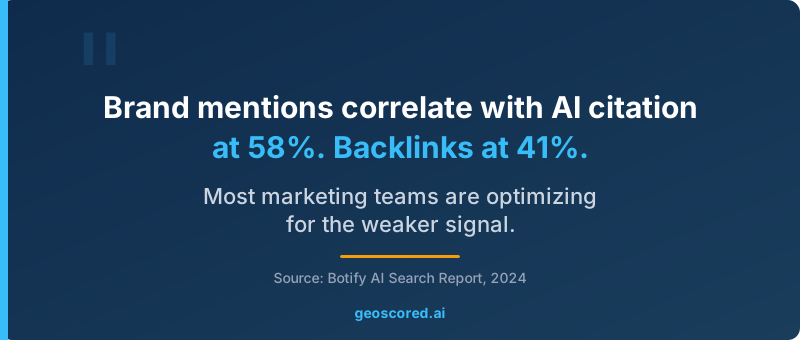
Ahrefs analyzed 75,000 brands to identify which signals correlate with appearing in AI-generated answers. Branded web mentions scored a correlation of 0.664 with AI Overview visibility. Traditional backlinks scored just 0.218 in the same dataset. Brand mentions outperform backlinks for AI visibility by a factor of three. Most marketing strategies are still optimizing for the weaker signal.
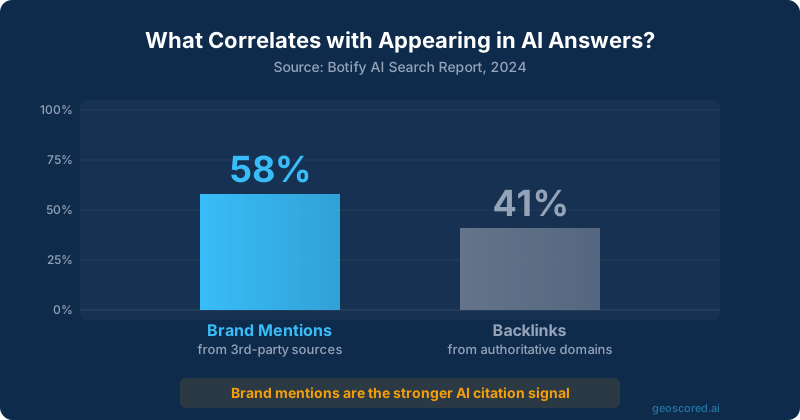
This does not mean backlinks are worthless. SEO (Search Engine Optimization) still matters. But the companies that will dominate AI-generated answers are building brand entity strength alongside their link profiles, not instead of them. The ones that only build backlinks will watch their AI visibility stagnate regardless of their domain authority score.
Consistency matters as much as volume
It is not just how many sources mention your brand. It is whether those sources agree.
A 2025 AI visibility study found that brands present across four or more platforms are 2.8x more likely to appear in ChatGPT responses. AI engines treat inconsistent descriptions as low-confidence signals. When they encounter contradictory data, they reduce their certainty about your brand and cite you less.

Most brands accumulate inconsistent entity data over time without realizing it. A company rebrands and the old name persists on 40 directory listings. A product pivot changes the core category but press coverage from three years ago still describes the original offering. LinkedIn describes the company one way. Crunchbase says something different. The AI's understanding of your brand reflects all of that confusion. You are paying the price in AI citations without knowing the source of the problem.
The five entity signals AI engines evaluate
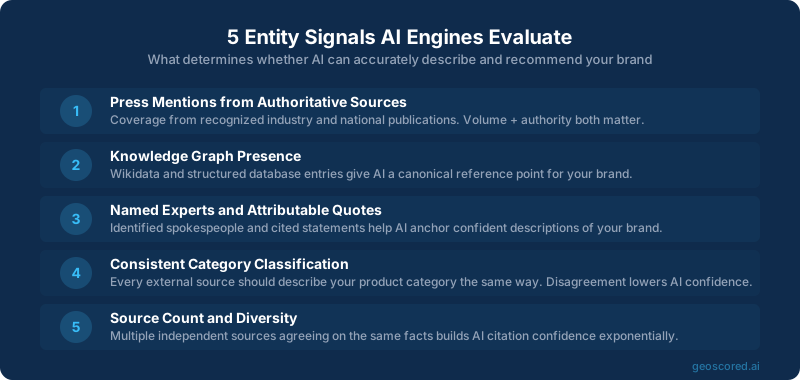
AI engines evaluate brand entity strength through five specific signals:
Press mentions from authoritative sources. Coverage from recognized publications builds entity confidence. Not every mention counts equally. A citation in a major industry publication carries more weight than 50 directory listings.
Knowledge Graph presence. Brands that appear in Wikidata and similar structured databases give AI engines a canonical reference point. Without this, AI systems have to synthesize your brand description from scattered sources.
Named experts and attributable quotes. Brands with identified spokespeople and attributed statements are easier for AI to cite with confidence. Anonymous content doesn't anchor well.
Consistent category classification. If every source that mentions you describes your product category the same way, AI engines can describe you accurately to someone asking about companies in that space.
External source count and diversity. AI engines build confidence from multiple independent sources describing the same facts. One authoritative source helps. Five independent sources agreeing is substantially stronger.
What AI is actually saying about your brand right now
Common patterns when brands first audit their AI brand presence:
- The AI does not know the brand exists
- The AI misidentifies the product category
- The AI describes a version of the product that predates a major rebrand
- The AI conflates the brand with a similarly named competitor
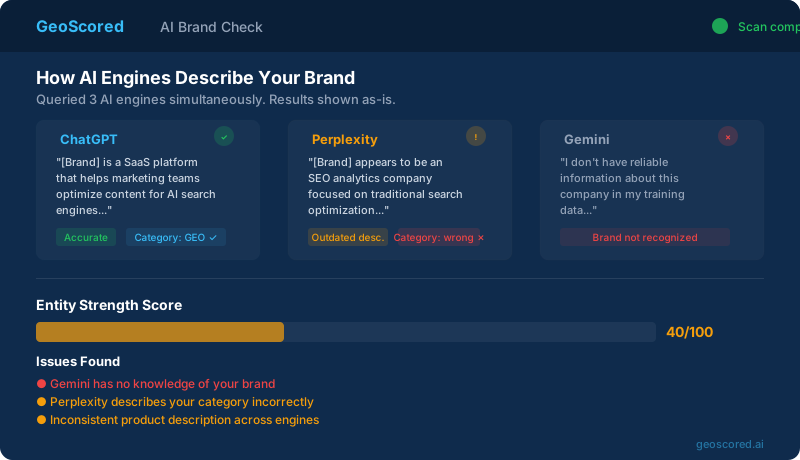
None of these are edge cases. They represent the current state of how AI engines understand most mid-market brands. AI systems build their knowledge from what's publicly available and consistently described. If the public record is sparse or contradictory, the AI's representation of your brand will be too.
What to do about it
The gap between knowing your AI brand reputation is weak and actually fixing it comes down to five actions, in order.
Get a baseline. You cannot prioritize without measurement. GeoScored's AI Visibility Screening checks 8 aspects of your AI readiness — including the AI Brand Check, which queries AI engines directly and shows you exactly how they currently describe your brand, what they get right, and where the description breaks down. That output is your starting point.
Audit your brand listings across major directories. LinkedIn, Crunchbase, G2, industry association directories, and your Google Business Profile should all describe your company using the same category language, the same product positioning, and the same founding details. Inconsistencies across these sources are the most common and most correctable source of AI entity confusion.
Establish one canonical description and propagate it. Write a single 2-3 sentence description of your company: what it does, who it serves, and how it differs from alternatives. Use this description verbatim in your LinkedIn About section, Crunchbase summary, website meta description, and any directory profile you control. AI engines build confidence from repetition across independent sources.
Establish a structured entity record. Wikidata is the primary structured knowledge base used by AI systems to anchor brand entities. Creating a Wikidata entry for your company with your official website, founding date, location, and industry classification gives AI models a canonical reference point that doesn't require them to synthesize your description from scattered mentions. This is one of the highest-impact single actions a brand can take for AI visibility.
Build authoritative citations, not just mentions. Not every mention carries equal weight. A profile in a recognized industry publication, a quote attributed to a named spokesperson, or coverage in a vertically authoritative source contributes more to brand entity confidence than general web mentions. Prioritize getting cited in sources that AI training pipelines treat as authoritative in your category.
Find out where you stand
The only meaningful starting point is measurement. AI search visibility tools split into two categories: monitoring tools that track what AI says about you, and audit tools that tell you what to fix. Start with the audit.
ChatGPT has over 800 million weekly active users as of February 2026. Perplexity is processing over 1 billion queries per month, up from 780 million in May 2025 and growing. When those users ask about companies in your industry, they get an answer. That answer is being formed right now, from whatever entity data currently exists about your brand in the public record.
Run your AI brand check at geoscored.ai.
Sources
- Ahrefs: Analysis of AI Overview Brand Visibility Factors, 75K Brands - Ahrefs, 2025
- Ahrefs: Top Brand Visibility Factors in ChatGPT, AI Mode, AI Overviews - Ahrefs, 2025
- The Digital Bloom: 2025 AI Citation and LLM Visibility Report - The Digital Bloom, December 2025
- ChatGPT Statistics February 2026 - DemandSage, February 2026
- Perplexity AI Statistics 2026 - DemandSage, 2026 (780M queries reported May 2025; estimated 1B+ by early 2026)